
Sema Fonkem 18/08/2025
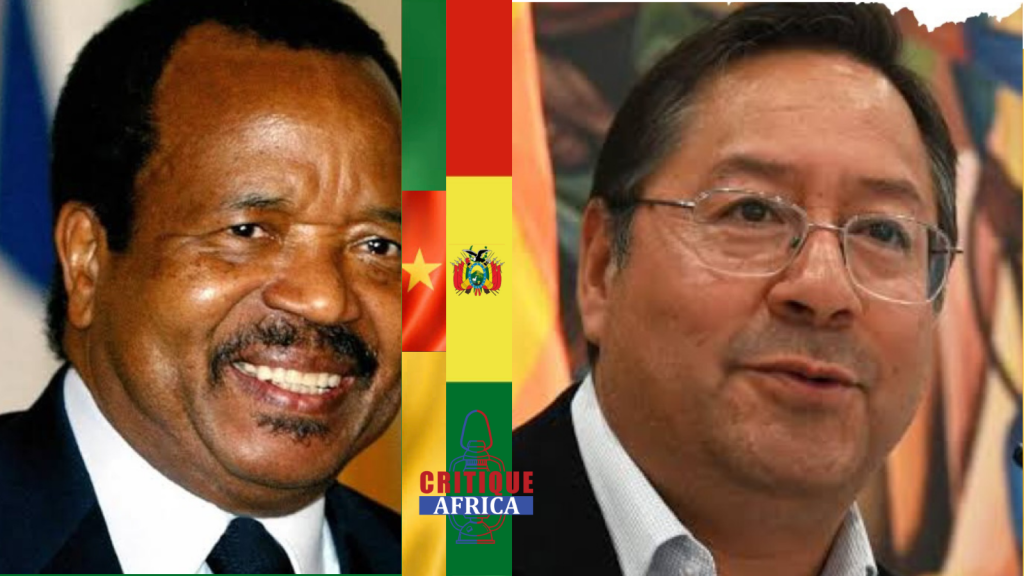
While both Bolivia and Cameroon are preparing for their presidential elections coming up in October 2025, these are some common factors between their geopolitical and economic landscapes.
Bolivia’s presidential runoff is set for October 19 2025 and Cameroon’s presidential election is scheduled for October 12 2025.
Bolivia and Cameroon share some similarities despite being geographically distant. Both countries have substantial tropical forest areas, with Cameroon having a larger portion of its land covered by forests . They are also both experiencing urbanisation but Bolivia is more developed overall, and both experience periods of economic difficulty and structural adjustment policies. Additionally, both countries are faced with a trend of increasing demand for products from their forest areas.
A detailed breakdown:
Both Cameroon and Bolivia are republics with a presidential system of government . In both countries, the president serves as both the head of state and the head of government.
Here’s a more detailed breakdown:
- Republics: Cameroon and Bolivia are both republics, this means they have a system of government where power is held by the people and their elected representatives.
- Presidential System: In both countries, the president is the head of state and the head of government, holding significant executive power. Presidents have the final say in all state affairs.
- Unitary State: Bolivia and Cameroon are unitary states where power is concentrated in the central government with all head offices in the capital city.
- Separation of Powers: Both countries have a separation of powers among different branches of government, typically including executive, legislative, and judicial branches.
Forest Resources:
- Both Bolivia and Cameroon, along with Indonesia, are considered representative of the world’s three largest tropical forest regions: the Amazon Basin, the Congo Basin, and Insular Southeast Asia.
- Cameroon and Bolivia both have a significant portion of their land covered by tropical forests.
- While Indonesia has the highest deforestation rates, Cameroon and Bolivia also experience deforestation at a slower pace.
2. Economic Context:
- Both countries are faced with economic challenges and have undergone structural adjustment policies.
- Bolivia continues to experience economic difficulties while Cameroon has seen more recent, but slow, economic growth.
- Bolivia and Cameroon had a similar per capita GNP of between $700USD to $900.00USD in the early 1990s.
3. Increasing Demand for Forest Products:
- Both countries have seen increasing demand for products derived from their forest areas.
- This demand can impact the management and capacity of governments to sustainably manage their forests.
Differences
Cameroon and Bolivia, both republics, exhibit key differences in their governmental structures. Cameroon operates as a unitary semi-presidential republic, while Bolivia is a unitary presidential republic . In Cameroon, the President and Prime Minister share executive power, whereas in Bolivia, the President holds both head of state and head of government roles.
Cameroon:
- Type of Republic: Unitary semi-presidential republic.
- Executive Branch: The President and Prime Minister share executive power.
- Form of Government: Power is centralized in the state, and the president has significant influence.
Bolivia:
- Type of Republic: Unitary presidential republic.
- Executive Branch: The President serves as both head of state and head of government.
- Form of Government: The President is the dominant figure in the executive branch.
Key Differences:
- Power Distribution: Cameroon’s semi-presidential system divides executive power, while Bolivia’s presidential system concentrates power in the President.
- Prime Minister’s Role: In Cameroon, the Prime Minister plays a significant role in government, whereas in Bolivia, the President’s role is more prominent
- Leaders: Cameroon is currently ruled by 92 years old president Paul Biya who has been in power for 43 years on a two-term restructured mandate while Bolivia’s incumbent Luis Arce was on seat for his first five years with no limit to the number of terms a president may serve before resigning and seeking asylum in Mexico.
- Independence: Bolivia gained in dependence on August 06 1825 and has a record of 67 presidents while Cameroon in the past 200 years. Cameroon on the hand gained in 1961 (Southern Cameroon’s from Great Britain) and 1960 (French Cameroon from France). Only two presidents have been into office in the last 64 years.
 Critique Africa